Pinocchio and the Fox: Victim and Deceiver
Pinocchio (Tania Zamorsky Edition)Pinocchio and the Fox are linked first as deceiver and victim, then as former victim and unrepentant beggar. The Fox helps divert Pinocchio from his errand to Geppetto, and later joins the Cat in taking his money. Their final encounter reverses the balance: impoverished and diminished, the pair ask Pinocchio for help, but he recognizes them, refuses, and answers their old fraud with the proverb that stolen money never bears fruit.
The First Betrayal and Its Consequences
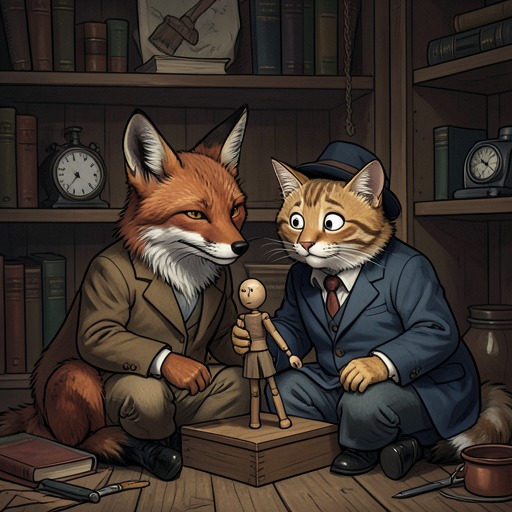
Pinocchio’s account to Geppetto traces the Fox’s part in a chain of misfortunes that began when Geppetto sold his coat to buy Pinocchio a primer. Instead of going to school, Pinocchio went to see the puppets. After the puppet master gave him five gold coins to carry home to his father, Pinocchio met the Fox and the Cat, who led him to the Red Lobster Inn. The pair ate heartily; Pinocchio was left to set out alone at night. His account places the encounter at the start of a disastrous sequence, although the immediate betrayal that brought him into danger was only one episode in a much longer wandering. The Fox and the Cat’s deception continued when Pinocchio trusted them with his remaining money. He had spent one of the five coins at the inn, and the two persuaded him to bury the other four in the hope that they would multiply. When he returned, the money was gone. Pinocchio’s recollection gives the loss a bitterly inflated scale: he had expected thousands of coins and found nothing. His belief in the promise of effortless gain made him vulnerable, but the Fox’s role was active—the promise drew him into a scheme that served the pair, not him. The consequences extended beyond the theft itself. While pursuing Pinocchio, the assassins hanged him from the Great Oak; the Blue-Haired Fairy had him taken away and revived. Later, after returning to the place where he had hoped to find her, Pinocchio heard from the Pigeon that Geppetto had set out in a little boat to search for him. Pinocchio flew toward his father with the Pigeon, but Geppetto’s boat overturned in rough water, and the Great Shark swallowed him. In recounting all this to Geppetto, Pinocchio folds the Fox’s betrayal into a compressed history of his own repeated errors and their widening costs.
A Reunion After Reversal
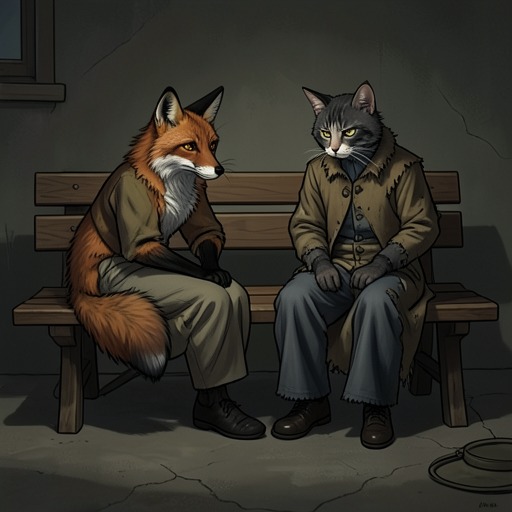
The Fox reappears near the end of Pinocchio’s journey, not as a confident guide but as one of two figures sitting by the roadside and asking for alms. Pinocchio and Geppetto have set out in search of a house or hut where they might receive a little bread and straw for a bed. Before they have gone a hundred paces, they see the Fox and the Cat. The change in their circumstances is immediate and visible: they are described as wretched and unrecognizable from their former selves. The Cat has become truly blind after pretending to be blind, while the Fox has grown old and lost one side of his body. She has no tail; reduced to extreme poverty, she sold her beautiful tail to a traveling merchant, who bought it to make a flyswatter. The Fox’s former talent for persuading others has not disappeared altogether. She appeals to Pinocchio’s pity by presenting herself and the Cat as two poor invalids, and the Cat echoes her plea. Their need is real, but their performance still recalls the practiced deception through which they once manipulated him.
Recognition and Refusal
Pinocchio does not mistake their appeal for a new beginning. He identifies them as the same pair who deceived him before and refuses to be drawn back into their confidence. His answer makes the reunion a test of recognition: he remembers not only that they tricked him, but also the specific lesson of the stolen coins. He tells them that they deserve their poverty and invokes the proverb that stolen money never bears fruit. The Fox and the Cat continue pleading, but their appeals do not change his decision. The refusal marks a reversal in their relationship. Earlier, the Fox and the Cat controlled the story Pinocchio believed: they offered a shortcut to riches, and he followed their instructions. Now Pinocchio controls the terms of the encounter. He can distinguish their present hardship from the false promises that once won his trust, and he does not confuse recognizing their suffering with owing them assistance. The scene gives his refusal a particular edge: he and Geppetto are themselves seeking food and shelter, yet the Fox’s old victims will not surrender what little they have to the pair who robbed Pinocchio.
The Relationship’s Meaning
The Fox’s appearances connect temptation to consequence across Pinocchio’s wandering. The inn, the vanished coins, and the later roadside plea form a sequence: the Fox first helps entice Pinocchio away from school and home, then participates in a scheme that takes his money, and finally confronts him after the fortune promised by deceit has failed to materialize. The Cat’s physical decline and the Fox’s lost tail make that reversal concrete, while Pinocchio’s proverb turns it into an explicit judgment on the pair’s past conduct. Their last exchange does not undo the harm or restore trust. Instead, it shows that Pinocchio has learned to recognize the Fox without accepting her version of events or her request for aid. The relationship therefore measures a change in his judgment: once persuaded by the prospect of easy wealth, he now sees the cost of the Fox’s promise and refuses to repeat his earlier mistake. Her final appearance makes the old deception answerable to the very person it once exploited.